

“So what shall we do for the Easter hols?” I asked my husband a few weeks ago.
“How about camping?” he said, and before I could ask if he was kidding or something, he also said the magic words: camping in Derbyshire.
I do like camping, don’t get me wrong, but camping in April is not exactly my cup of tea. Still, I’d happily put up with almost anything for the chance to go back to my most favourite part of the world.
So earlier this month we did go camping in Derbyshire. I have to admit that when I got up at some ungodly hour in the morning, I might have muttered “Blimey, there’s ice on this tent!!!” But ice or no ice, it was worth it. Some of us had a whale of a time cycling (Derbyshire has some of the best cycling tracks I’ve ever seen, converted from disused railways). And some of us went to Pemberley of course – and a few other gorgeous places.
One of those was Bakewell. Jane Austen is said to have visited it in 1811. Cars and buses aside, she might have recognised the main road and the Rutland Arms Hotel, though maybe not the Old Original Bakewell Pudding Shop established after her time, in the 1860s.
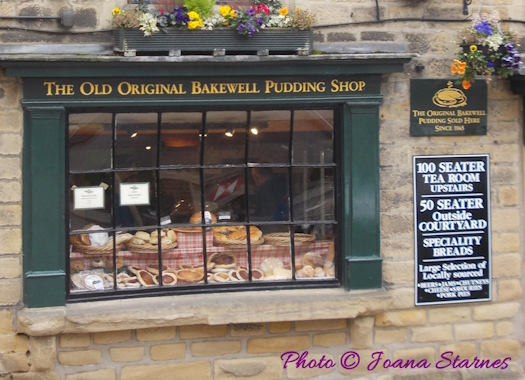
(‘The Original Bakewell Pudding Sold Here since 1865’)
From Bakewell there’s a couple of miles’ walk to Ashford-in-the-Water, a gorgeous little village, a gem in itself. But it has one more claim to fame: the stone that was used to decorate the elaborate Baroque chapel at Chatsworth had been quarried from here.
The village is recorded as Aisseford in the Domesday Book. It grew around a ford over the River Wye on an ancient trading route known as the Portway, established in Roman times.
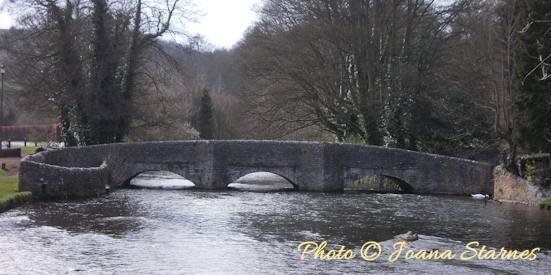
Other than the odd aerial poking up on top, the cottages look like they haven’t changed much in 200 years. Neither has the medieval packhorse bridge, built over the Wye near the site of the old ford. Until recently, sheep were brought to be washed in the river before being sheared, and were penned in the stonewalled enclosures on the left. The ewes, with halters around their necks, were pushed into the water, ducked and made to swim downstream, to rejoin their lambs on the bank.
The Derbyshire tradition of well-dressing is kept in Ashford as well as in a few other places (one of the most notable ones is Tissington, some 10 – 15 miles south as the crow flies). Intricate pictures are made pressing alder cones, flower petals, moss and other natural materials into a background of wet clay. Several wells are dressed in Ashford for Trinity Sunday and remain in place for about a week. If you ever find yourself in Derbyshire at well-dressing time (usually in May) and you can tear yourself from Pemberley, then Tissington and Ashford are certainly worth a visit.
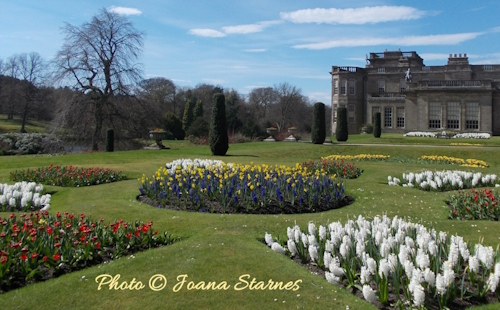
In my case, I don’t think I could have stayed away from Pemberley for very long. I went to Lyme Park first and, unlike my visit last summer, this time the weather was absolutely glorious, and so were the spring flowers.
A few days later, I found that Chatsworth was bathed in glorious sunshine too:
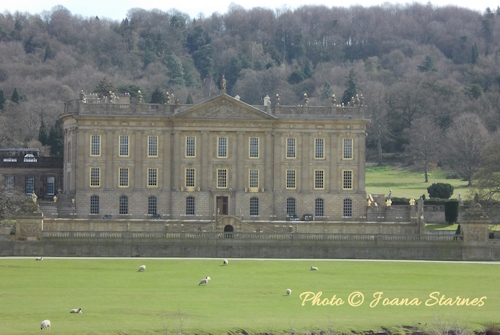
Chatsworth is a truly amazing place with a wealth of history. The stunning Painted Hall took my breath away, but no less than the thought that, unlike so many others, this grand estate had survived all the challenges that hundreds of years had thrown at it, is still owned by the family who had built it, and they share it with the rest of us in so many inspired ways and with such welcoming grace!
Amongst other things, I learned that the name of the famous Georgiana, Duchess of Devonshire is pronounced ‘Geor-jay-nah’. I wonder if that’s the case for Georgiana Darcy too, if that’s the way the name was pronounced at the time. Surely not. It doesn’t sound quite right for Miss Darcy – not to me anyway.
I wasn’t thinking of Chatsworth when I wrote the camellia scene in my first book, ‘From This Day Forward – The Darcys of Pemberley’ (a scene where Elizabeth awakes in their London home to find a camellia on her pillow, in the middle of winter). But it was a lovely surprise to discover that camellias have a special place at Chatsworth. The old hothouse shelters a wonderful collection, and as early as April they are blooming in the gardens too.
I wish I had visited Chatsworth a little later in the year. Magnolias looked like they were just about to burst into flower, and the flowerbeds held fantastic promise but they were still pretty bare. It was just narcissi and daffodils that bloomed everywhere, dotting the grounds in specs of white and gold.
Many learned people still debate whether Jane Austen was inspired by Chatsworth in creating Pemberley. She might have been – or not. But one look at the grounds was enough to show that Mrs. Gardiner might easily have spoken of Chatsworth when she said:
“If it were merely a fine house richly furnished, I should not care about it myself; but the grounds are delightful. They have some of the finest woods in the country.” (Pride and Prejudice, Chapter 42)
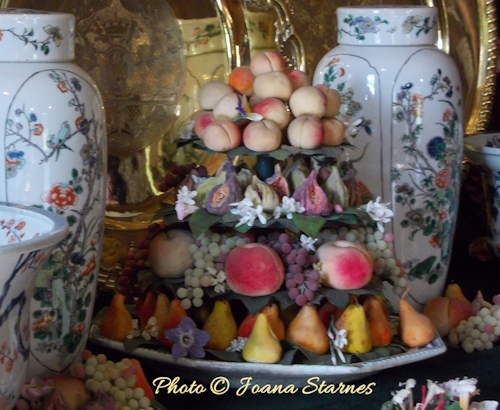
I also wonder if Jane Austen might have seen a display similar to this one when she wrote:
“There was now employment for the whole party; for though they could not all talk, they could all eat; and the beautiful pyramids of grapes, nectarines and peaches soon collected them round the table.” (Pride and Prejudice, Chapter 45)
Mr. Darcy’s bust is not in the sculpture gallery any longer. It holds pride of place next door, in the Orangery Shop. I wish the portrait commissioned for the 1995 adaptation was as faithful a representation of the original – or at least that it was kept at the property!
Which brings me to my final stop on the Pemberley tour: Sudbury Hall. Sadly, the music room is bare these days. It was only furnished for the adaptation. But they’ve recently acquired a beautiful Broadwood square piano and it’s placed exactly where Georgiana sat down to play, while our favourite couple exchanged ‘The Look’.
I’ve always wondered how the National Trust, who are always so very careful and punctilious to a fault, allowed the use of candles, and likewise allowed Darcy’s whippets to roam through the house. Little did I know that as Darcy was striding, candle in hand, through the moonlit gallery with his dogs, to go back to the music room and dream of Elizabeth, he was followed closely by someone carrying a fire extinguisher, and the dog handler was just around the corner too.
I’ve also learned a quirky little story about the intricate Gringling Gibbons woodcarvings that adorn the drawing room at Sudbury and many of the rooms at Lyme Park, especially the music room. At Lyme Park they said that the artist had a little signature piece: a peapod that he would incorporate in every carving. If he was paid, the peapod would be open. If he was not, the peapod would be closed, for everyone who visited the country-house to see and smirk, if they were in the know. But the opinion of a lady at Sudbury Hall was that it might have been a myth, because how would he know while he was carving whether he would be paid or not? “Besides, she added, this peapod is closed but I know he’s been paid and we’ve got the receipt to prove it.”
The Queen’s Room a.k.a. Darcy’s bedchamber was having a great overhaul, with the bed dragged to the middle of the room and stripped down to its framework, but the Long Gallery was as beautiful as ever, as was the grand staircase.
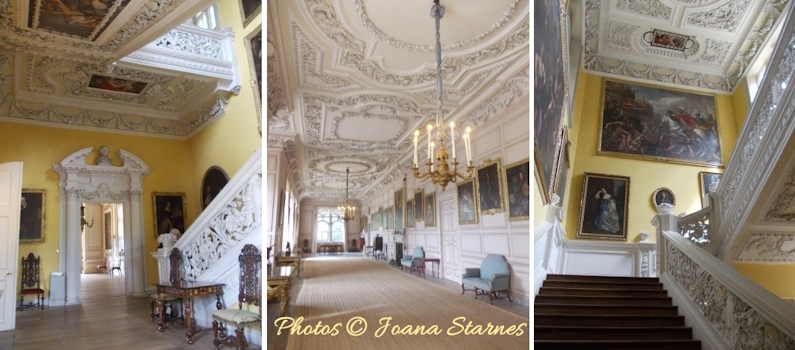
Not even the temptation of National Trust scones could drag me out of the house, and my family nibbled their treats without me. I could have stayed for ever and photographed every square inch of plasterwork. Not possible, of course. But I’ll be back, and with any luck, I might meet you there someday!


 Joana Starnes
Leave a comment