

They say never go shopping for food when you’re hungry. Writing a post on Georgian dishes when you’re hungry isn’t the best idea either. Luckily, I can’t nip into the kitchen to snack on plovers’ eggs, Nelson’s pudding or oyster patties, so I’m probably safe, at least for now. These were just a few of the recipes – or rather receipts – I found in Mrs Rundell’s book, published in 1808. Along with similar compilations from Hannah Glasse, Elizabeth Raffald and Eliza Acton, Mrs Rundell’s book gives us a mouth-watering glimpse into the world of Georgian cookery.
Jane Austen’s heroes and heroines don’t prattle on about food. Neither do the other characters whom we are encouraged to respect. That office is left to the likes of Mrs Bennet, Miss Bates, Mrs Jennings, Mr Woodhouse or Mrs Norris. Thus, we are never to learn if Mr Darcy does indeed employ French cooks, nor what elegant dinners are served at Pemberley. If we would like more details about the world of Jane Austen’s characters, we must seek them elsewhere.
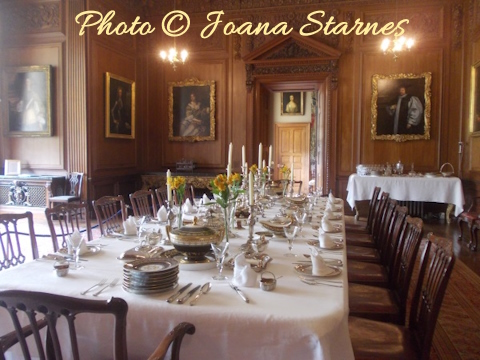
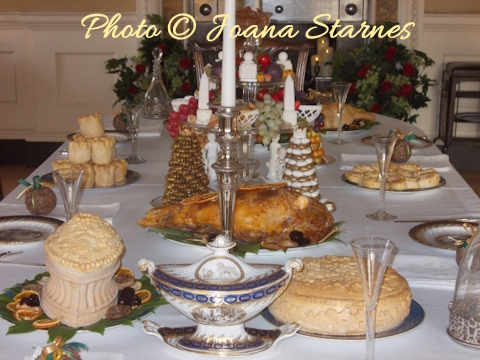
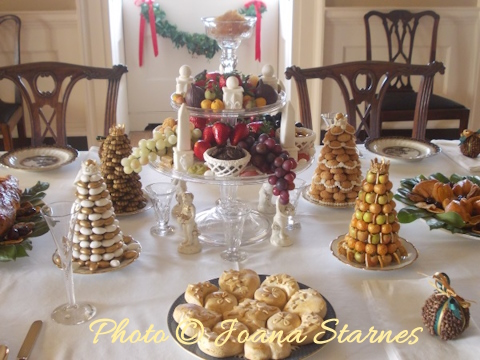
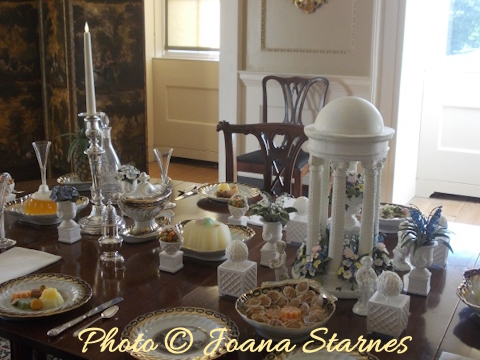
It’s a pity that, however dedicated and determined we might be, we can’t really hope to recreate the atmosphere and the lavish display of a Pemberley dinner. We don’t live in grand houses, we don’t have an army of (underpaid) kitchen maids and scullions, and we can only dream about Mr Darcy and his French cooks. But we can feast our eyes on dinner tables laid out as if in expectation of Mr and Mrs Darcy’s guests.
The delightful dining rooms at Lyme Park and No. 1 Royal Crescent in Bath might give us an idea of what dinners at Pemberley might have looked like:
As for those who toiled to prepare such delicacies, The Complete Servant, written by Samuel and Sarah Adams, upper servants themselves, tells us that a country gentleman with a young family and an income of £16000 a year would be expected to employ at least 26 indoor and outdoor servants, among which a housekeeper, ‘a French Man-Cook’, one or two kitchen maids, two dairy maids, a still-room maid and a scullery maid (also known as a scullion).
On her husband’s income, Mrs Bennet would have had to make do with a housekeeper, a cook (probably female, and certainly not French), a kitchen maid and a scullion, while on their £500 a year Mrs Dashwood, Elinor and Marianne could only have a cook and a maid-of-all-works in their kitchen at Barton Cottage.
The Complete Servant is just a guide, and in practice the number of servants varied. For example, in 1819 the 5th Earl of Stamford’s household included a housekeeper, an English cook (male), four kitchen maids, a dairy maid and two still-room maids. Most of them were expected to travel with the family between the London townhouse and the two country estates, Enville and Dunham Massey.
Even if the family did not belong in the highest circles and did not entertain lavishly, cooking for the Georgians was no mean feat. In most houses, grand or humble, cooking was still done over an open hearth, as had been the case for centuries. Pots, kettles and griddle pans were suspended over the fire from wrought iron cranes that allowed them to be raised, lowered, or swung out. The meat was roasted on spits worked by a mechanical device – (1) in the image below – or by a smoke-jack in the chimney (a vane turned by the upward current of hot air and smoke). A hastener (2) might be used, so that the joint would be exposed to heat on all sides.
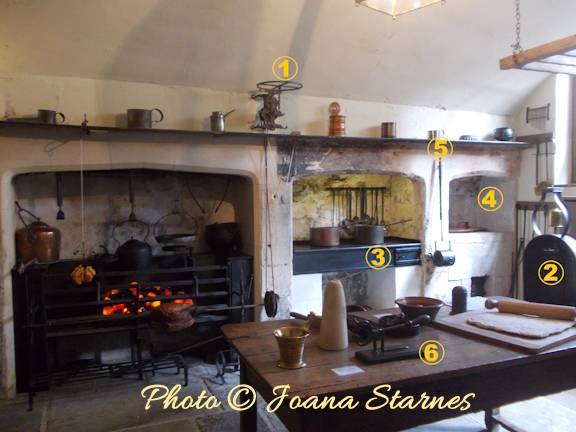
The Kitchen at No. 1 Royal Crescent, Bath
Most of the time, a fire was also burning under a large lidded copper vessel (4) to provide a constant supply of hot water for the kitchen and the rest of the household. Bread was baked in a separate brick oven that could be found either in the kitchen or in the bakehouse. Kitchen ranges started making an appearance from 1780, and included a closed oven to one side and a boiler on the other.
What the Georgians lacked in labour-saving modern-day appliances, they certainly made up in the variety of utensils. One of my favourite places is the kitchen at No 1 Royal Crescent, Bath. It’s made to look as if the cook had just stepped out, and it’s said to house one of the largest collection of Georgian kitchen implements in the country. The display includes a coffee beans roaster and sugar clippers – (5) and (6) in the image above – pie and jelly moulds, butter stamps, butter scales, spinach presser, cabbage presser, toasting rack, ale muller, apple corer, potato slicer, vegetable chopper, pastry cutters, pigeon skewers, pewter plates, whisks, scoops, saucepans of all shapes and sizes, and many more besides. I’m still wondering in what way a spinach presser is different from a cabbage presser, and why a cook would need both. I guess I’ll never know.
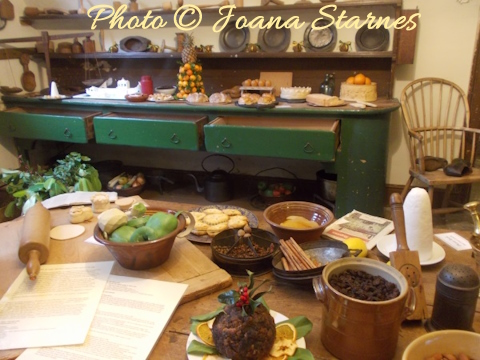
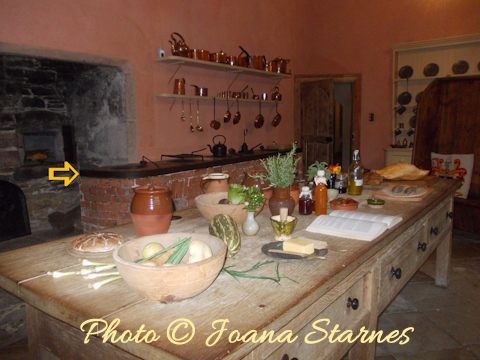
Delicate sauces that required gentler handling were prepared on a hotplate heated by a flue running under it, and bringing hot air from the nearby fire. In its place, in the kitchen of No. 1 Royal Crescent there is now a modern appliance (3) used for cooking demonstrations, but the first image below still shows the original hotplate:
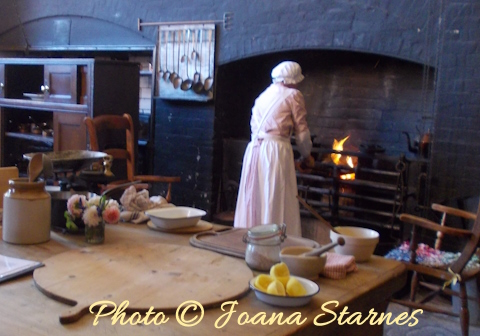
A housekeeper worth her salt would also supervise the preparation of pastries and confectionery in an adjoining pastry room (unless the household was grand enough to employ a pastry-cook for the purpose), and she would also oversee the still-room maids in the preparation of household remedies and cosmetics.
To our good fortune, records of the time, including the collection of recipes compiled by the Austens’ friend Martha Lloyd, allow us to discover what might have been prepared in those kitchens. We might never sit down for a true Georgian dinner. We might not have enough time and courage to attempt to cook Sauté of pheasants with truffles, Turbot with lobster sauce, Partridge galantines or Salmagundy – and indeed we might lack the sturdy constitution needed to consume them. Yet, thankfully, we can find enough fodder for our imagination to be able to picture dinners at Pemberley, Netherfield, Donwell or Enscombe, with glittering plate, cheerful and animated company, and tables so laden that the mere thought of them would make Mr Woodhouse blanch and ring for his basin of thin gruel.
Salmagundy must have been as pretty as a mosaic – but it probably packed quite a punch to the liver. It consisted of neatly-arranged layers of cold chicken breast or veal; yolks and whites of hard-boiled eggs; half a dozen anchovies; beetroot; red pickled cabbage; ham; grated tongue ‘and any other thing well-flavoured and of a good colour,’ Mrs Rundell tells us. The sliced ingredients were layered into a dish in such a way as to create the greatest variety of colour between the rows, and were garnished with curled butter and parsley.
Butter, cream, eggs, sugar and ground almonds abound in Georgian recipes. Few, apart from Mr Woodhouse’s gruel, have a low-sugar/low-fat content. But if we forget about modern-day dietary principles for a moment and read on, we find a delightful variety of dishes, from Lobster Soup, Fricandeau of Veal, Trout à la Genevoise and Shoulder of Venison, that might have found their way to Mr Darcy’s table, to less exotic-sounding ones such as Stewed Ox-Cheek, Staffordshire Beef Steaks and Potted Rabbit.
Jane Austen’s friend Martha Lloyd listed a Receipt of Curry after the Indian Manner, Macaroni with Butter and Parmesan, Swiss Soup and Ragoo of Celery with Wine among the family favourites.
Perhaps Mr Darcy’s French cooks might not have sent up a steaming dish of stewed ox-cheek, but Jane Austen enjoyed it (she said so in one of her letters to her sister), and chances are that the Bennets would have dined on that as well on some of the days when they weren’t entertaining guests with partridges cooked to a turn and soup fifty times better than the one Mrs Bennet had at Lady Lucas’ table.
‘Waste not, want not’ was a concept held in high regard in sensibly-run households, and even Mrs Bennet might have seen its merit when she wasn’t trying to impress potential suitors.
The kitchen and stillroom at Longbourn must have been a bustling place. I wonder whose job it was to follow Mrs Glasse’s receipt and make the ‘Hysterical Water’. Mrs Hill’s? Jane’s? Elizabeth’s? The poor soul assigned to that task must have been very busy, because with five unmarried daughters, a nervous disposition and a husband who delighted in vexing her, Mrs Bennet must have needed gallons of it.
“Take Betony [a plant of the mint family], Roots of Lovage, Seeds of wild Parsnip, of each two ounces. Roots of single Peony two ounces; of Mistletoe of the Oak three ounces; Myrrh a quarter of an ounce; Castor half an ounce. Beat all these together and add to them a quarter of a pound of dried Millipedes. Pour on these three quarts of Mug-wort water, and two quarts of Brandy. Let them stand in a closed Vessel eight days, then distil it in a cold Still posted up. You may draw off nine pints of water and sweeten it to your Taste. Mix all together, and bottle up.”
If you weren’t born and raised in the eighteenth century, don’t try this at home. Have a sip of ratafia instead and let’s think about syllabubs, cakes and sweetmeats.
Mrs Raffald tells us how to make a Syllabub under the Cow:
“Put a Bottle of strong Beer and a Pint of Cider into a Punch Bowl, and grate in a small Nutmeg. Sweeten it to your Taste, then milk as much Milk from the Cow as will make a strong Froth and the Ale looks clear. Let it stand for an Hour, then strew over it a few Currants, well washed, picked and plumped before the Fire. Then send it to Table.”
If your cows are out grazing, you might resort to your supermarket-bought full-fat bottle of milk instead. And I guess the currants could be plumped in the oven for a bit, if you don’t have an open fire.
Mrs Rundell tells us how to preserve fruit and bake all sorts of fanciful cakes. But sometimes a nice cup of tea and a slice of ‘common cake’ does the trick. I think I’ll have a go with this recipe, it seems easy enough:
“Mix three quarters of a pound of flour with half a pound of butter, four ounces of sugar, four eggs, half an ounce of caraways and a glass of raisin wine. Beat it well and bake in a quick oven. Fine Lisbon sugar will do.”
I hope modern-day caster sugar will do likewise, and that I can use some other sweet wine instead of raisin wine. Or maybe pull all the stops and add a glass of sherry instead.
There is also a recipe for orange biscuits, which Mrs Rundell says ‘are useful to carry in the pocket on journeys, or for gentlemen when shooting.’ The name is rather misleading, because they’re not biscuits/cookies as we know them, but shapes cut from a paste made of boiled and drained oranges mixed with an equal weight of refined sugar.
Seeing as even Miss Bingley admits that Elizabeth has good teeth, our favourite heroine probably doesn’t make free with the sugar clippers and doesn’t stuff her pockets with those orange biscuits when she goes travelling. Which is just as well, because she’s travelling a lot in my current WIP, sometimes in the best company.
She and her travelling companions are in no rush. They take their time and stop at several inns along the way. They’re dawdling, almost. Food is the last thing on Elizabeth’s mind, of course. She has much better things to think of. But it was lovely to get the mental picture of the sort of welcome they received at the coaching inns. This paragraph is from Thomas Hughes’ Tom Brown’s Schooldays set in the 1830s. Some twenty years later than I’d like it to be but, coaching inns couldn’t have changed that much in twenty years, at least not until the advent of railways.
“The table covered with the whitest of cloths and of china, and bearing a pigeon-pie, ham, round of cold boiled beef cut from a mammoth ox, and the great loaf of household bread on a wooden trencher. And here comes in the stout waiter, puffing under a tray of hot viands; kidneys and a steak; transparent rashers and poached eggs, buttered toast and muffins, coffee and tea, all smoking hot. The table can never hold it all; the cold meats are removed to the sideboard, they were only put on for show, and to give us an appetite.”
Have fun this summer, with or without pigeon-pie and cold boiled beef cut from a mammoth ox, and happy travels!
References:
Adams, Samuel and Sarah – The Complete Servant (1825), Edited by Ann Haly, introduction by Pamela Horn, Southover Press, 1989
Acton, Eliza – Modern Cookery In All Its Branches Reduced to a System of Easy Practice, For The Use of Private Families – Second Edition, Longman, Brown, Green and Longmans, London, 1845
Raffald, Elizabeth – The Experienced English Housekeeper, R. Baldwin, London, 1786
Glasse, Hannah – The Art of Cookery Made Plain and Easy, L. Wangford, London, 1747
Rundell, Maria – A New System of Domestic Cookery Formed Upon Principles of Economy and Adapted to the Use of Private Families, John Murray, London, 1808
Black, Maggie and La Faye, Deirdre – The Jane Austen Cookbook, British Museum Press, 1995
Lane, Maggie – Jane Austen and Food, Hambledon Press, 1995
Murray, Venetia – High Society in the Regency Period, Penguin Books, 1998
Quennell, Marjorie and C.H.B – A History of Everyday Things in England, Batsford, 1960.
Sambrook, Pamela – A Country House at Work, Three Centuries of Dunham Massey, The National Trust, 2003
Woodforde, James – The Diary of a Country Parson 1758 – 1802, Oxford University Press, 1978


 Joana Starnes
Leave a comment