
Would you like to have a closer look at the sort of carriages that our favourite characters might have used to travel around town or dash up and down the country? Then let’s stroll through the Carriage Museum at Arlington Court in North Devon. There are around 50 vehicles in the collection, the oldest dating back to 1698, but you won’t be surprised to hear that it was the ones from the first half of the 19th century that I lingered around and photographed from every angle.
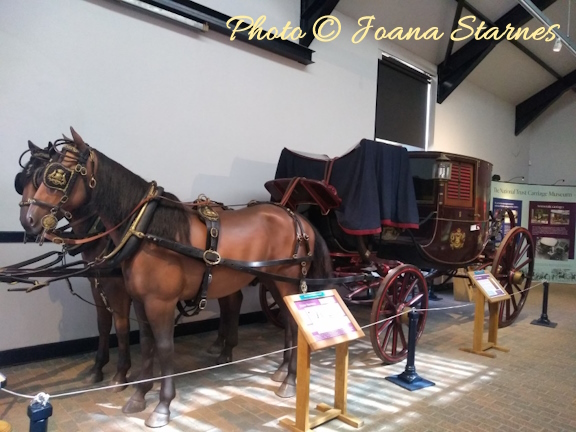
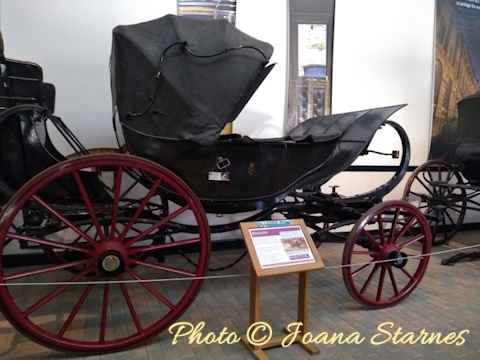
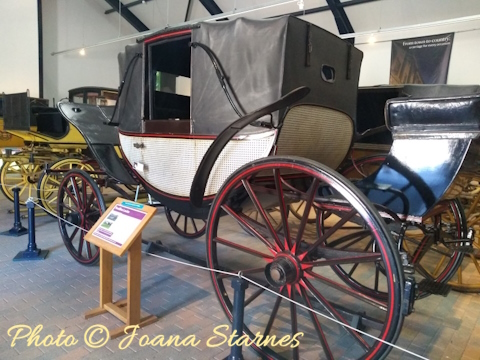
Some have been restored and repainted, others are preserved in their original condition, but they all have one thing in common: these are not gleaming replicas meant as props for period dramas. They’re the real deal. Young ladies in ball gowns have been handed into these carriages. Gentlemen in top hats and greatcoats have travelled along turnpike roads and up and down the cobbled streets of Georgian London in these very vehicles, to deal with affairs of state, look after their interests, spend time with their friends and court their brides-to-be.
The chariot featured below has journeyed even further afield. Mr Gibbs Crawfurd Antrobus of Eaton Hall, Cheshire, used it when he attended the Congress of Vienna (1814-1815) as a junior secretary under Lord Castlereagh. So that’s a round trip of some 2300 miles, and it’s still in excellent condition (no mean feat, given the state of the roads at that time).
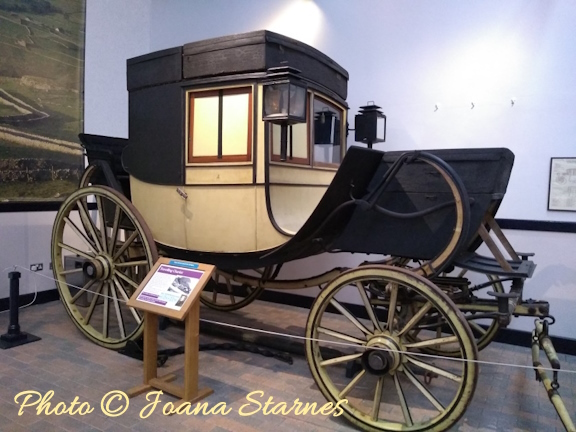
Of all the carriages on display at Arlington Court, I think this is my favourite. I love the connection with the end of the Peninsular War. I love to think that, while this chariot was making its way across Europe, people were reading the recently published Pride and Prejudice. I love the understated coat of arms, which can just about be spotted beneath the window. I can’t help thinking that Mr Darcy’s coat of arms would have been just as discreetly displayed. Lady Catherine, on the other hand, or the likes of Sir Walter Elliot, would have had their coats of arms plastered all over the carriage door and made visible from a hundred paces. But what I loved the most were the details that clarified a number of points for me.
Whenever I wrote scenes involving travel, all sorts of questions popped to mind. Just how large were the carriages, for instance, and how far off the ground? Could a lively, spirited and impatient young lady leap out without waiting for the step to be lowered? (Actually, yes, at a push, but she’d have to be as active and agile as Elizabeth Bennet 🙂 ). How many attendants could be taken along? And last but not least, how on earth did they find enough room for the luggage? After all, one could not be seen wearing the same attire time after time, and Regency gowns and tailcoats would have taken up an awful lot more space than a pile of rolled-up T-shirts. Elizabeth and Maria went to Hunsford with a few small trunks tied to the back of Sir William’s carriage, but what about Mr Darcy, Mr Bingley and the Hursts, who would travel with a couple of footmen in attendance?
I read somewhere that most of the trunks could be sent ahead on waggons in preparation for a lengthy stay in town or when the family returned to the country. But the Antrobus chariot showed me that there were other options: the imperials (wooden suitcases covered in leather and strapped to the roof) and two luggage compartments at the front of the vehicle. The bulge at the back is a sword case.
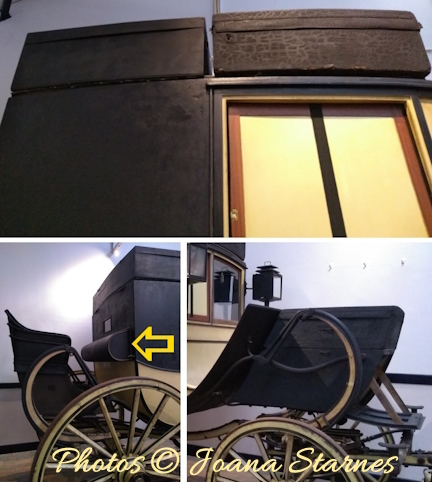
Other models could also offer extra space. If they were postilion-driven, the coachman seat could be flattened, and trunks could be piled up in its place.
Some carriages meant for long-distance travel such as the grand tour could be equipped with a dormeuse boot (an extension that allowed the occupants to stretch out at full length and sleep while travelling).
You can find out more on the National Trust Carriage Museum website, and if you’d like to have a look at other vehicles in the collection, most of them are available here.
Which one is your favourite?
Have fun exploring, and thanks for reading.
Sources: Information boards at The National Trust Carriage Museum and https://www.nationaltrust.org.uk/arlington-court-and-the-national-trust-carriage-museum/lists/the-national-trust-carriage-museum


 Joana Starnes
Leave a comment