

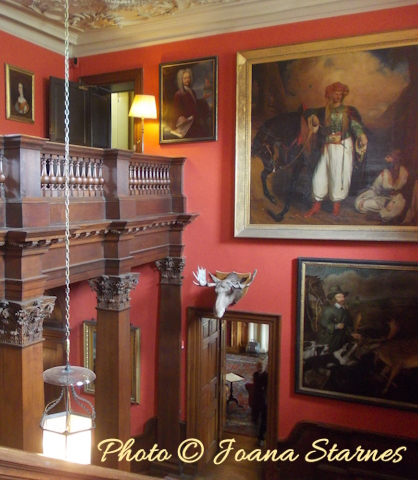
Good morning. Would you like to come on another virtual trip with me? It starts in Liverpool, at a boarding school for young ladies of good fortune, and finishes at Pemberley, which is no surprise. All the stories I’d like to share with you finish at Pemberley. But this time the heroine is not Elizabeth. This post is about a young lady who, at the tender age of fifteen, was swept into a whirlwind of deceit that seems lifted straight from the pages of an angsty novel. I came across her story a few years ago, when I went down the rabbit hole researching elopements. Then, some time afterwards, I visited Lyme Park and found several display boards about the life and times of one of its owners, Thomas Legh (1792-1857) whose large portrait in Turkish attire dominates the grand staircase at Lyme. (You can find a close-up at https://www.nationaltrustcollections.org.uk/object/499989 )
His own story is fascinating too. He was the son of Colonel Thomas Peter Legh (1754 – 1797) who died unmarried, leaving behind seven illegitimate children born to seven different mothers, one of whom (Thomas’s mother) was a young woman in the colonel’s employ. Thomas was not his eldest son. Even so, for reasons known only unto the colonel, Thomas was the one chosen to inherit the bulk of Colonel Legh’s fortune.
Thomas Legh travelled extensively, and upon his return to Lyme he received a lavish welcome in honour of his twenty-first birthday. The display boards at Lyme gave a detailed description of the festivities, but there was another notice, placed at the end of the Long Gallery, that caught my eye. It said that in 1828 he married Ellen Turner, who a couple of years previously had been at the centre of a drama that had captured the nation’s attention.
I couldn’t believe my eyes. ‘I’ve heard of Ellen Turner,’ I thought, and found it so exciting that I had stumbled upon a link that was completely unexpected. I would have loved to see her portrait too, but sadly I could not find one, neither at Lyme Park, nor online.
Miss Turner was the only daughter of William Turner of Shrigley Hall, a wealthy mill-owner from Cheshire. To her misfortune, she caught the eye of Edward Gibbon Wakefield, a fortune hunter who was shown to be far more skilled and villainous than Wickham. Playing on her youthful innocence and her affection for her parents, Wakefield conspired with his brother and step-mother to trick her into an elopement and marry her for her inheritance.
He started off by sending his servant to Ellen’s boarding school with a message claiming that her mother had suffered an attack of apoplexy, that Mrs Turner had been left paralysed and wished to see her daughter as soon as possible. The mistresses of the boarding school allowed her to leave with the bearer of the tidings, but Ellen was not escorted to Shrigley Hall. Instead, she was taken to Manchester and delivered into Wakefield’s hands.
From then on, Wakefield proceeded to spin a web of lies. Charming and suave, he introduced himself as her father’s friend, told her that her mother was not ill after all, and claimed that he had been sent by Mr Turner to escort her to Kendal, where her father was waiting for her. But, once arrived in Kendal, Ellen discovered that her father was not there. She was promptly told another tall tale. Wakefield solemnly said that he had some grave news to break to her: namely, that the Macclesfield bank upon which her father’s business relied had collapsed, that Mr Turner was ruined, and had been forced to flee to escape his creditors. Wakefield claimed that Ellen’s father had entrusted him with the mission of conveying her further north to Carlisle, where Mr Turner was allegedly in hiding.
Of course, when they reached Carlisle, Ellen found that Mr Turner was not there either. Enter Wakesfield’s brother, who claimed that Mr Turner’s attorney had devised a scheme to rescue a large part of his client’s fortune. It was in Ellen’s power to preserve her father from financial ruin, the villainous brothers said. All she had to do was marry Edward Wakefield. Then he would return her marriage portion to her father, and Mr Turner would be saved. Wakefield’s brother assured Ellen that the scheme had her father’s full support. He claimed that Mr Turner had spoken with him in person and charged him to convey his consent for the marriage to take place. Young, vulnerable, confused and frightened, Ellen complied. She agreed to cross the border into Scotland, and married Edward Gibbon Wakefield in Gretna Green on 8 March 1826.
Wakefield was not new to this game. Ten years earlier, he had eloped with another heiress, Eliza Pattle, a ward of chancery. Eliza’s mother had accepted the situation in order to avoid a scandal, and eventually settled £70 000 on the couple. When Eliza passed away in childbirth, Wakefield assumed that the ploy would be just as successful a second time.
He was mistaken. Mr Turner was resolute and well-connected. Although Wakefield had made every effort to prevent Ellen from seeing her parents and took her to Leeds, then to London, and eventually to Calais, Mr Turner was able to enlist the help of the Foreign Secretary, and a warrant was issued for the arrest of Edward Gibbon Wakefield and his brother William.
Before long, Ellen was brought home, and the Wakefield brothers were committed to Lancaster Castle to await trial. They were indicted in August 1826, at the Lancaster assizes, along with their stepmother. Edouard Thévenot, the servant who had lured Ellen away from her boarding school, had not been apprehended, and had been indicted as an accomplice in absentia.
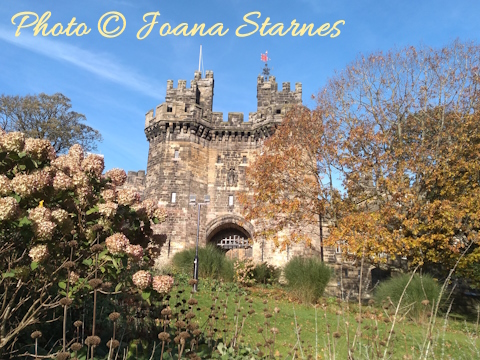
There must be plenty of tongue-in-cheek euphemisms for ‘being in prison’. One of the relatively modern ones is ‘spending some time in Her [His] Majesty’s Bed & Breakfast,’ which certainly applies to Lancaster Castle. For the last six hundred years or so, the Castle has been owned by the reigning monarch as part of the Duchy of Lancaster, and for much of that time it had been a ‘working castle’ rather than a royal residence. Until recently, it was a working prison (decommissioned in 2011) and still serves as a Crown Court (it’s thought to be the oldest continually sitting Crown Court in the country).
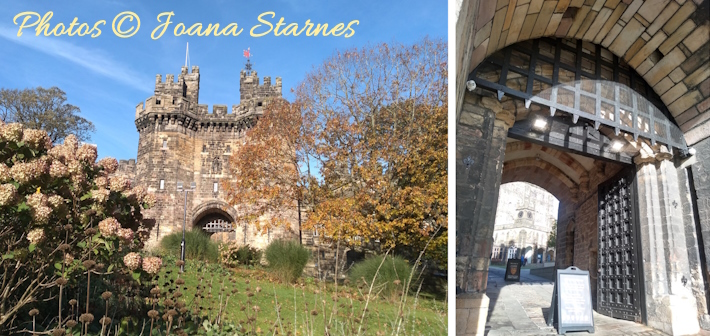
The downside of it still serving as a Crown Court is that photography is not allowed in that section of the Castle, which is a pity, because the 18th century New Crown Court and Shire Hall are a sight to see.
In the Jury Room I came across another link to the Wakefield brothers’ nefarious scheme: a painting depicting the trial of Edward Gibbon Wakefield, William Wakefield and Frances Wakefield (their stepmother) for conspiracy and for the abduction of Miss Ellen Turner. I don’t have a photo of it, but luckily I found it on Art UK, and you can view it here: https://artuk.org/discover/artworks/a-sketch-in-the-shire-hall-trial-of-edward-gibbon-wakefield-1826-150796
The three defendants were put on trial in Lancaster on 23 March 1827, and on the same day the jury found them all guilty. On the following day, they were committed to Lancaster Castle. The stepmother, whose role seemed to have been limited to information gathering, was granted an early release, but the Wakefield brothers served three years, Edward in Newgate and William in Lancaster Castle.
Edward Gibbon Wakefield’s marriage to Ellen Turner was annulled by Act of Parliament in June 1827. A year earlier, when Ellen’s uncle had traced the couple to Calais, he had prevailed upon Wakefield to sign a statement attesting that the marriage had not been consummated. I can’t help wondering about that. Wakefield seems to have had ample opportunity, and a ruthless determination to establish himself as Mr Turner’s son-in-law and lay claim to Ellen’s inheritance. Given his general conduct, he does not strike me as a person given to generosity of spirit or delicacy of feeling. But this is idle speculation. Have a lovely day, and thanks for reading.
Sources:
https://en.wikipedia.org/wiki/Shrigley_abduction
https://teara.govt.nz/en/biographies/1w4/wakefield-edward-gibbon
https://en.wikipedia.org/wiki/Leghs_of_Lyme


 Joana Starnes
Leave a comment